The Science Olympiad Plane was built according to rules for "Wright Stuff" competition in 2015. Wing span must not exceed 50 cm (19.7 inches), with a wing chord of 8.0 cm (3.15 inches) or less. Wing area must be under 400 sq cm, or 62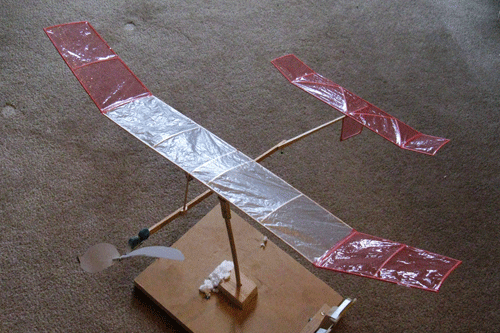 square inches. Total airframe mass, without the rubber motor, must be more than 8 grams. The maximum weight of the rubber motor is 2.0 grams, about the weight of a 12 inch loop of 1/8 inch wide FAI Tan rubber. The maximum propeller diameter was 240 mm ( 9.45 inches ), and may be home-made or commercially sourced. I tried to proportion my plane like the Chuck Markos Double Whammy, as far as moments and wing offset were concerned. Unlike my Whammy, the wing ribs in this plane are cut to a simplex camber, like those in the Limited Penny Plane version. I used polyethylene film for the covering.
I tested smaller and larger propellers before settling on a 225 mm diameter one with flexible plastic blades from IKARA in the Czech Republic. Weight with that propeller and a 1.8 gram rubber motor (14 inch loop of 0.093 inch wide FAI Tan) was 9.6 grams. Wing loading is 0.8 ou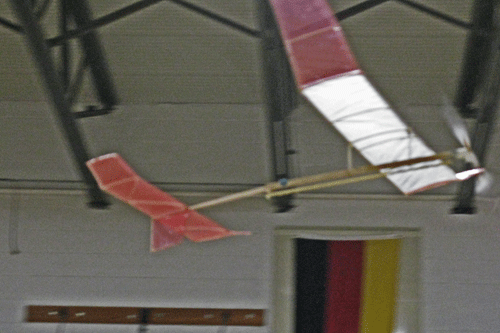 nces per square foot and cube loading is 1.2 ounces per cubic foot. This is a bit heavier than the loading for the Double Whammy. Winding the 14 inch loop to about 1200 turns gave flights of over 2 minutes with this plane in a school gym with about a 20 foot ceiling, where the inflight picture was taken, and at Rantoul, IL, in an old Hangar with a a higher ceiling. At Science Olympiad Nationals in May 2015, 6 planes made flights lasting between 4 and 5 minutes, and 24 teams had flight times over 3 minutes.