
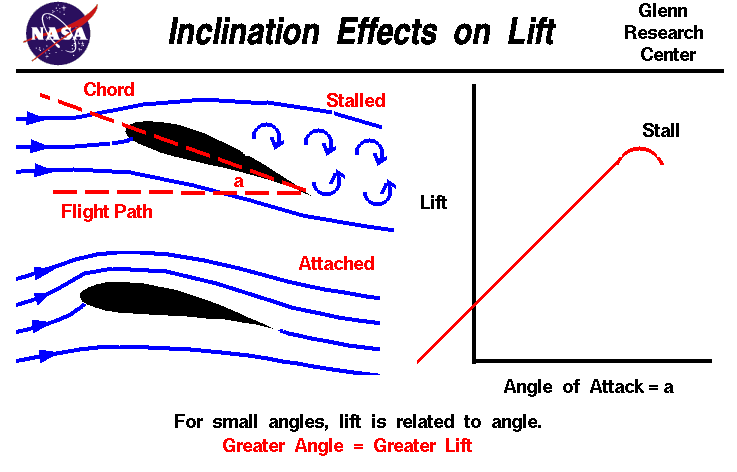
Airplanes rise into the sky because they transfer the momentum they have from forward motion into an upward component called lift. According to Newton, if the airplane pushes the air, the air pushes back. This works for all shapes of wings, but for some better than others, when the combination of angle of attack and drag are accounted for. There is another effect, discovered by Bernoulli, that aids lift, especially with airfoils of efficient shape. We need to account for the air going over the wing, that is changing speed and direction.
There is a Wikipedia article that goes into this a bit deeper than we might like, but has some interesting flow simulations included. https://en.wikipedia.org/wiki/Lift_(force)
NASA summary pages relating to lift refer to a simulation program, without a lot of explicit references to equations: https://www.grc.nasa.gov/WWW/K-12/airplane/lift1.html
One of them discusses the wrong way to explain the relation of Bernoulli's equation and lift : https://www.grc.nasa.gov/WWW/k-12/airplane/wrong1.html
Another one says that wing shape aids in deflecting the air flow over the upper wing surface downward, thus increasing lift. Flaps use this strategy to increase lift at low speed.
https://www.grc.nasa.gov/WWW/K-12/airplane/shape.html
This NASA summary discusses the relation of lift and a wing's "angle of attack" with respect to the air. https://www.grc.nasa.gov/WWW/K-12/airplane/incline.html
Here is an MIT student's report on the Bernoulli effect as it applies to wings: https://web.mit.edu/2.972/www/reports/airfoil/airfoil.html